
The Mekong Delta – A Journey Through Vietnam’s Southern Wonderland
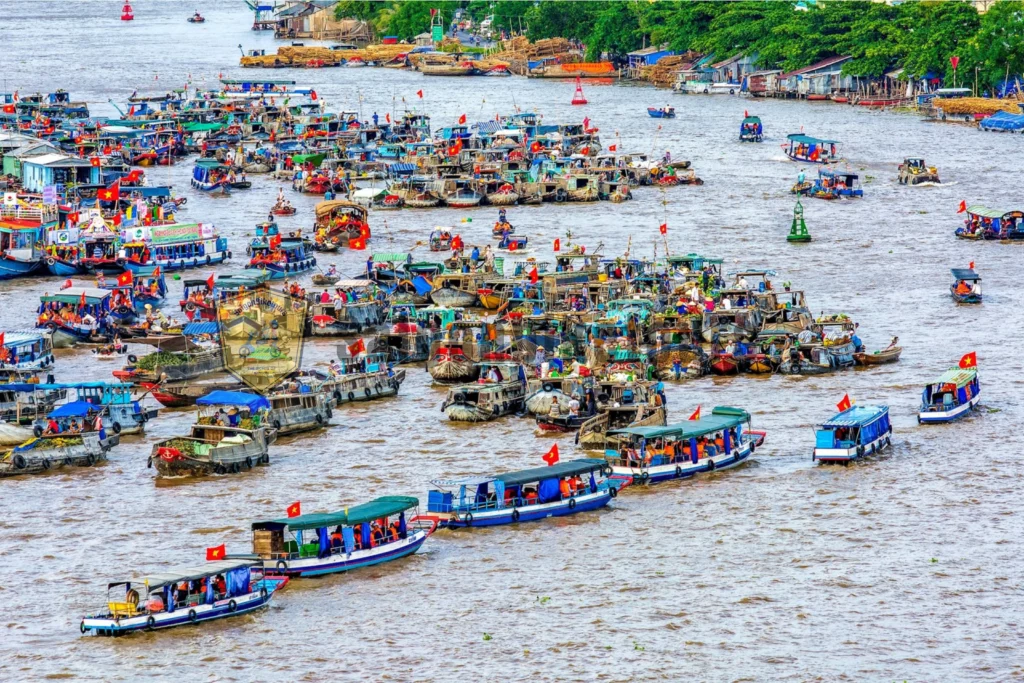
The Mekong Delta – A Journey Through Vietnam’s Southern Wonderland Overview The Mekong Delta, or “Dong Bang Song Cuu Long” in Vietnamese, lies at the southern tip of Vietnam. Covering over 40,000 square kilometers, it is a labyrinth of rivers, canals, rice paddies, and lush orchards. Known as Vietnam’s most fertile region, it provides the majority of the nation’s rice and a variety of agricultural products. History and Formation The delta was formed over millennia by sediment carried from the upper Mekong River. This river starts in the Tibetan Plateau, runs through China, Myanmar, Laos, Thailand, Cambodia, and finally Vietnam. As the river slows near its mouth, it deposits nutrient-rich silt, creating the fertile landscape we see today. Throughout history, this abundance attracted settlers, shaping a unique culture deeply connected to water. The Mekong River The Mekong River is not just a geographical feature but the very soul of the delta. It sustains agriculture, supports fishing communities, and serves as a major transportation route. Its seasonal floods bring new life, replenishing the soil and supporting biodiversity. Life in the Delta Daily life in the Mekong Delta revolves around waterways. Houses on stilts line the banks, and boats are used for transportation, fishing, and trading. Floating markets such as Cai Rang and Cai Be are cultural icons, where vendors sell fruits, vegetables, and cooked meals directly from their boats. See more: Can Gio – The ecological and cultural treasure of southern Vietnam The People The inhabitants of the Mekong Delta are known for their adaptability and friendliness. They have developed a way of life that embraces the challenges of flooding and changing water levels, turning them into opportunities for farming and aquaculture. Specialties The delta is a paradise for food lovers. It boasts tropical fruits like mangosteen, star apple, and dragon fruit, as well as iconic dishes like canh chua ca (sour fish soup), banh xeo, and coconut-based sweets. Seafood is abundant, with shrimp, catfish, and snakehead fish forming the basis of many meals. Tourism and Culture The Mekong Delta attracts tourists with its natural beauty, cultural richness, and laid-back lifestyle. Visitors can cruise along canals, cycle through villages, and enjoy homestays with local families. Festivals, folk songs, and traditional crafts add to the region’s charm. Conclusion The Mekong Delta is more than just a geographical region; it is a living, breathing testament to the harmony between humans and nature, offering both a vital agricultural base for Vietnam and an unforgettable cultural experience for travelers. ♥ Saigonbiketours – Food Tour In Saigon ♥
Cu Chi – History, Culture, and the Spirit of Vietnam
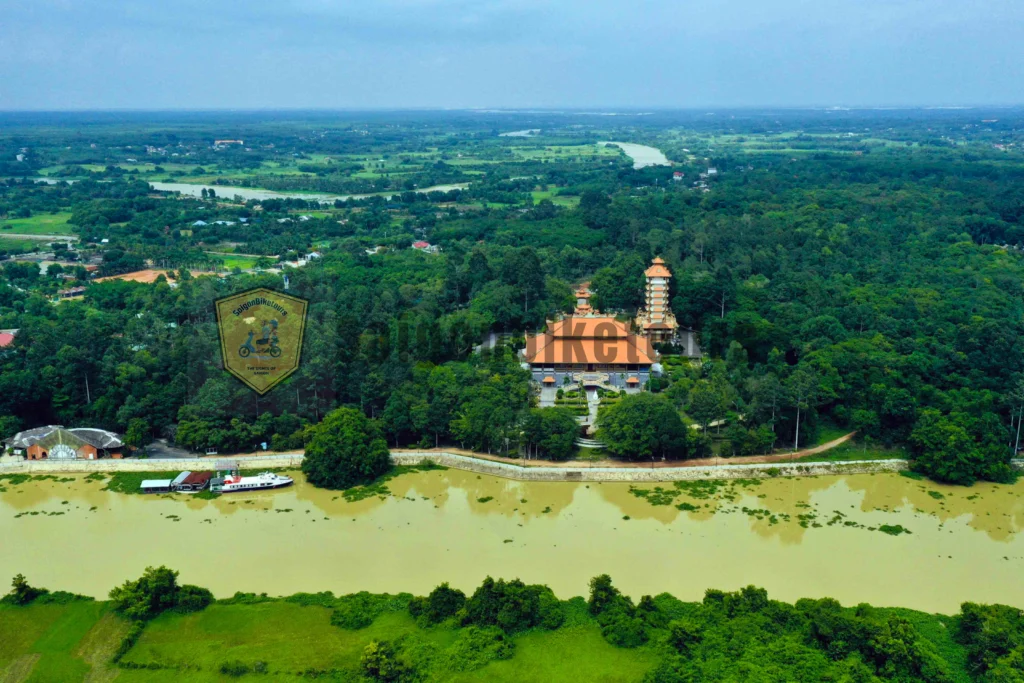
Cu Chi – History, Culture, and the Spirit of Vietnam Overview Cu Chi District lies about 60 kilometers northwest of Ho Chi Minh City. Known for its rural charm and deep historical roots, Cu Chi has transformed from a quiet agricultural region into a major tourist destination, drawing travelers interested in both history and culture. History Cu Chi’s history dates back hundreds of years, with the land once belonging to Khmer communities before becoming part of Vietnam. During the Vietnam War, Cu Chi became a strategic stronghold due to its location and the elaborate system of tunnels built by local residents and soldiers. This underground network, stretching over 200 kilometers, played a crucial role in resisting military campaigns. Origin of the Name The name “Cu Chi” is thought to derive from the Khmer phrase meaning “land of sand and trees,” referencing the region’s natural landscape in ancient times. Over time, as the Vietnamese settled here, the name remained, preserving a link to the district’s past. Cu Chi Tunnels Perhaps the most famous landmark in Cu Chi, the tunnels are an engineering marvel. Built with simple tools, they included living quarters, kitchens, storage rooms, and medical facilities. The tunnels allowed fighters to move undetected and withstand intense bombardment. Today, they are preserved as a historical monument, where visitors can walk through parts of the tunnels and learn about life during wartime. Local Specialties Cu Chi offers unique culinary delights such as cassava served with peanut and salt, rice paper used for fresh and fried rolls, and tropical fruits like durian, rambutan, and mangosteen. These dishes reflect the agricultural roots of the region and the resourcefulness of its people. The People of Cu Chi Residents of Cu Chi are known for their resilience, friendliness, and strong sense of community. Many families have deep connections to the land, continuing farming and traditional crafts while embracing tourism as a new source of livelihood. Tourism and Modern Development Today, Cu Chi combines historical tourism with eco-tourism and cultural experiences. Visitors can explore the tunnels, enjoy boat rides on nearby rivers, or visit local farms. This blend of history and nature ensures Cu Chi remains a vital part of Vietnam’s cultural landscape. ♥ Saigonbiketours ♥
Can Gio – The Ecological and Cultural Treasure of Southern Vietnam
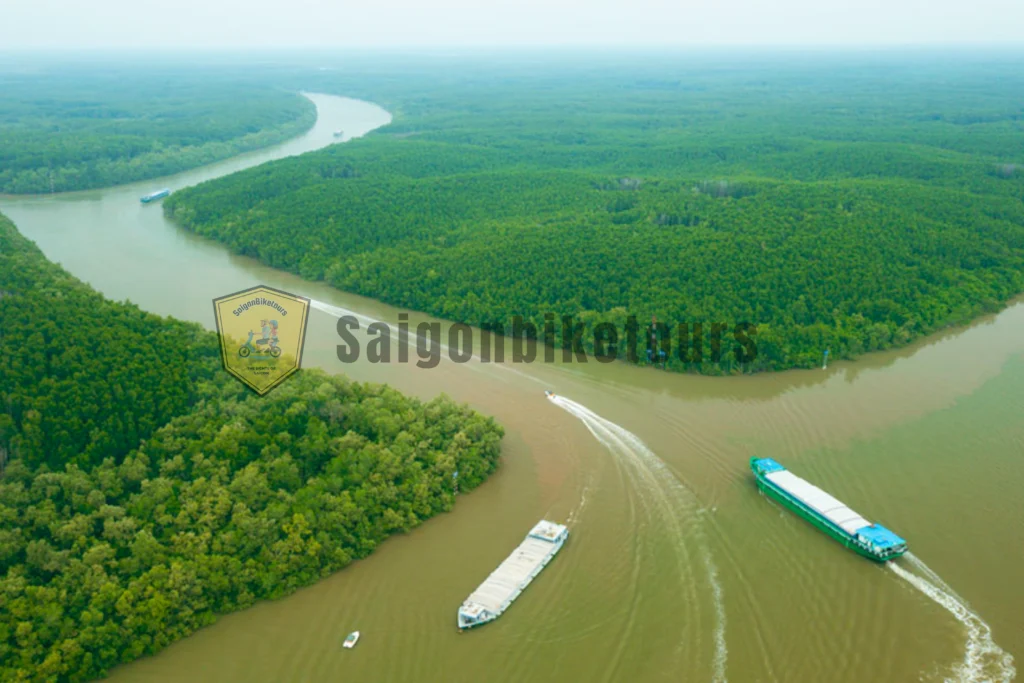
Can Gio – The Ecological and Cultural Treasure of Southern Vietnam Overview of Can Gio Can Gio is a coastal district of Ho Chi Minh City, located approximately 50 kilometers from the city center. Covering over 700 square kilometers, it is home to one of the largest mangrove forests in Vietnam. Recognized by UNESCO in 2000 as a World Biosphere Reserve, Can Gio plays a crucial role in protecting the region’s biodiversity and mitigating climate change impacts. The area is often referred to as the “green lung” of Ho Chi Minh City due to its vast forests and clean air. History of Can Gio The history of Can Gio dates back hundreds of years. Archaeological findings suggest that ancient communities once thrived in the region, engaging in fishing, salt production, and coastal trade. During the Nguyen dynasty, Can Gio was a strategic coastal area used for defense and maritime activities. In the modern era, the district has transformed into a hub for eco-tourism and sustainable industries while maintaining its traditional livelihoods. Salt-Making in Can Gio Salt production in Can Gio is a seasonal activity, typically taking place during the dry months. Local farmers prepare salt fields by leveling the ground and using clay to create shallow ponds. Seawater is channeled into these ponds and left to evaporate under the sun, leaving behind pure white salt crystals. Can Gio salt is known for its cleanliness and mineral richness, serving both domestic consumption and industrial purposes. Fishing and Aquaculture Fishing is the lifeblood of Can Gio’s economy. The district’s coastal waters are rich in seafood, including shrimp, crab, squid, and various fish species. Many families are involved in aquaculture, particularly shrimp farming, which provides steady income year-round. Fishing boats leave at dawn and return in the afternoon, filling local markets with fresh catches. These markets are not only economic centers but also cultural spaces where traditions are passed down. Tourism in Can Gio Tourism has become increasingly important to Can Gio’s economy. Key attractions include: ♦ Monkey Island (Dao Khi): Home to hundreds of playful monkeys and a historical guerrilla base. ♦ Vam Sat Ecotourism Area: Known for its diverse wildlife, including saltwater crocodiles and rare bird species. ♦ Can Gio Mangrove Forest: A UNESCO-protected area ideal for boat tours, birdwatching, and environmental education. ♦ 30/4 Beach: A tranquil spot for relaxation and seafood dining. Visitors are drawn to Can Gio for its unique blend of nature, history, and local cuisine. Seafood restaurants line the coast, offering dishes made from the day’s freshest catch. The Harmony Between Nature and People Can Gio represents a model of sustainable living, where residents balance economic needs with environmental preservation. Efforts to protect mangroves, regulate fishing, and promote eco-tourism have helped maintain the district’s ecological integrity. Local festivals and community events celebrate the connection between people and the sea, ensuring that traditions remain alive. Looking Forward As urbanization encroaches and climate change poses challenges, Can Gio faces the task of safeguarding its natural and cultural resources. With proper planning and community engagement, the district can continue to thrive as both a tourist destination and an ecological sanctuary. Can Gio’s story is one of resilience and coexistence—a reminder that preserving nature is not just an environmental responsibility but also a cultural heritage. ♥ Saigonbiketours ♥
Ca Na Salt Fields – The Soul of Ninh Thuan’s Coastal Culture
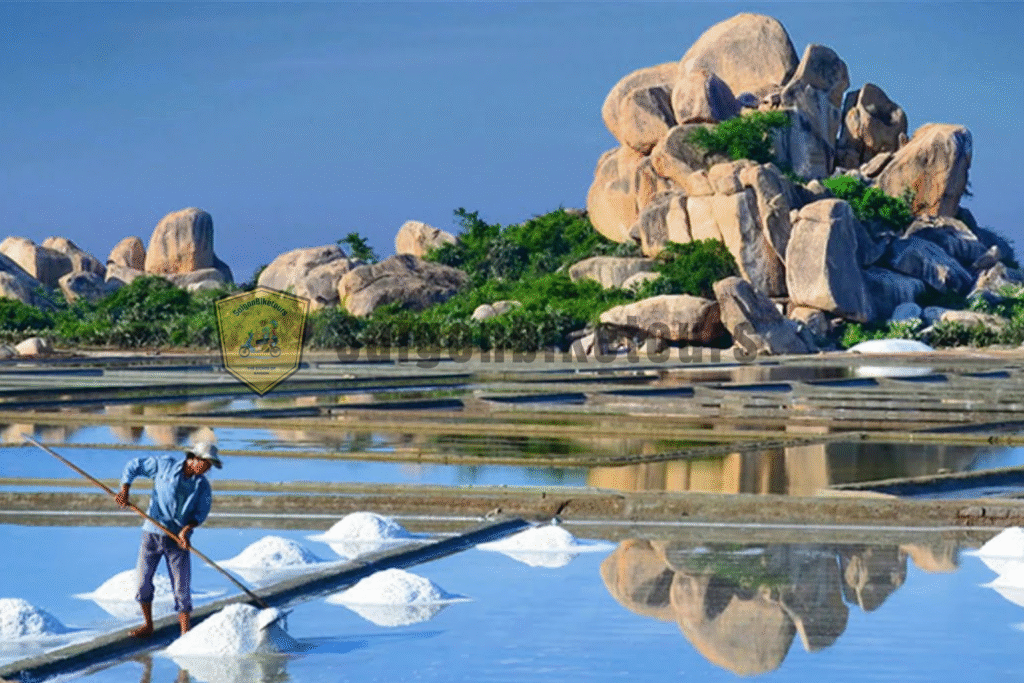
Cà Ná Salt Fields – The Soul of Ninh Thuận’s Coastal Culture Located in the coastal district of Thuận Nam, Ninh Thuận Province, Cà Ná Salt Fields represent one of Vietnam’s largest and most traditional salt-producing areas. With its abundant sunlight, low rainfall, and coastal plains, Cà Ná provides the perfect natural conditions for salt farming. The bright white salt pans stretching to the horizon have become not only a vital economic zone but also a symbol of cultural heritage. A Century-Old Tradition Salt-making in Cà Ná has a long-standing history that began over 100 years ago. Local oral histories and historical accounts suggest that salt production began here during the French colonial era when the demand for sea salt increased. Over time, the craft became an essential part of the community’s way of life, passed down from generation to generation. Salt-making is more than just labor—it’s a legacy. The Unique Process of Making Salt In Cà Ná, salt is produced mainly during the dry season, from December to August, when the sun shines intensely and the wind aids evaporation. The traditional process involves preparing salt fields by leveling the land and lining it with sand or clay. Seawater is then pumped into shallow ponds and left to evaporate under the sun. As the water evaporates, salt crystals form and are raked into piles, ready for collection. Despite the availability of industrial salt-making techniques, many families in Cà Ná prefer traditional methods. These methods ensure natural quality and purity and provide seasonal jobs for locals, particularly in poorer rural areas. Economic and Cultural Significance Cà Ná salt is not only consumed domestically but also exported to international markets. Its fine texture, mineral richness, and cleanliness have made it a favored choice for both household use and food processing. Economically, the salt industry supports hundreds of households in the region. It’s a major contributor to the local economy, especially in the dry months when agricultural activities are limited. Beyond economics, salt-making in Cà Ná is embedded in the culture. The sight of salt farmers working from dawn till dusk, the rhythmic movement of tools, and the sparkling fields at sunset form a poetic image of resilience and hard work. Local festivals and art forms often reflect this heritage. Challenges and Sustainability In recent years, salt farming in Cà Ná has faced challenges due to climate change, rising sea levels, urbanization, and economic shifts. Erratic weather patterns have affected the evaporation process, while some salt fields have been converted for tourism or aquaculture. However, many efforts are being made to preserve this traditional craft. Local authorities and NGOs are supporting sustainable salt production and promoting Cà Ná as a cultural tourism destination. Salt tours, where visitors can experience the process firsthand, are gaining popularity and offering alternative income for local communities. Looking Ahead Cà Ná Salt Fields remain a symbol of harmony between humans and nature. As Vietnam balances development with cultural preservation, the story of Cà Ná’s salt farmers stands as a powerful reminder of the value of tradition. Their perseverance, skill, and connection to the land deserve recognition and support. Whether viewed as an economic resource or cultural gem, Cà Ná’s salt fields continue to shine—literally and figuratively—under the Vietnamese sun. ♥ Saigonbiketours ♥
Sa Huynh Salt Fields – A Century-Old Craft and Cultural Heritage of Quang Ngai
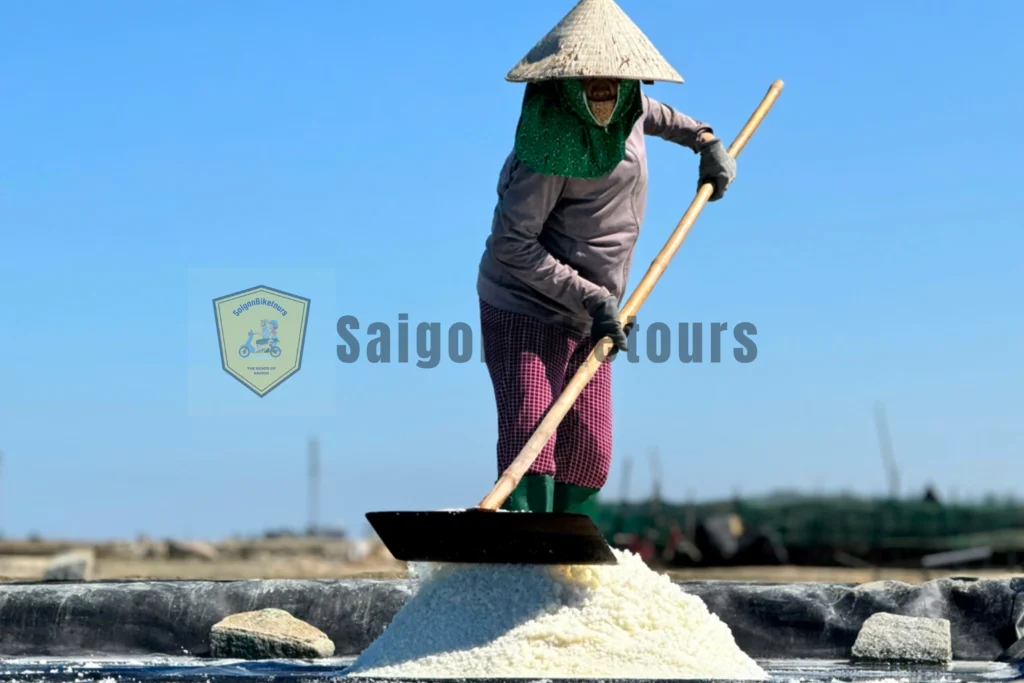
Sa Huynh Salt Fields – A Century-Old Craft and Cultural Heritage of Quang Ngai Nestled along the central coastline of Vietnam, the Sa Huynh salt fields in Duc Pho district, Quang Ngai province, are a remarkable representation of traditional salt-making in the country. This vast expanse of shimmering salt pans, white mounds, and hard-working farmers under the burning sun tells a story not only of a time-honored occupation but also of a deep cultural identity tied to the sea. More than just a source of salt, the Sa Huynh salt fields reflect the resilience, heritage, and livelihood of generations of local residents. An Overview of the Sa Huynh Salt Fields The salt fields of Sa Huynh stretch along the coast, forming a distinctive landscape of rectangular ponds and sparkling white salt beds. Covering dozens of hectares, this area is one of the most productive salt-producing regions in central Vietnam. Sa Huynh’s unique geographical and climatic conditions—including high temperatures, intense sunlight, and access to high-salinity seawater—make it an ideal location for salt production using natural evaporation. Every year, especially during the dry season from February to August, hundreds of local workers engage in the age-old task of making salt. The sight of salt farmers harvesting salt at sunrise or sunset has become iconic, drawing the attention of photographers and tourists alike. The Salt-Making Tradition of Sa Huynh The salt-making profession in Sa Huynh is more than just a job—it is a way of life. Passed down through generations, the techniques and tools used in salt production remain largely unchanged. Families often work together in the fields, with each member playing a role—from preparing the salt pans to collecting the final product. What distinguishes Sa Huynh salt-making from industrial salt production is its reliance on manual labor and natural processes. Unlike factories that use mechanical or chemical methods, Sa Huynh farmers depend solely on sun, wind, and skilled hands. This traditional method ensures the salt retains its natural minerals, flavor, and purity, which are highly valued in local markets. Historical and Cultural Origins Salt-making in Sa Huynh has a history that dates back over a hundred years. Oral histories from local elders suggest that the craft began in the early 1900s when coastal inhabitants realized the potential of the area’s natural resources. The long, sunny days and flat, open spaces made it feasible to build evaporation ponds and begin small-scale salt production. However, Sa Huynh’s relationship with salt may go even deeper. Archaeological findings in the Sa Huynh Culture—an ancient civilization that existed in the region over 2,000 years ago—suggest that salt was a vital commodity even in prehistoric times. Though modern salt production as we know it may have begun in the 20th century, it is likely that Sa Huynh has been a center of salt and coastal trade for much longer. Today, the tradition continues with pride, with many salt farmers seeing themselves not just as laborers but as custodians of cultural heritage. The Process of Making Salt in Sa Huynh The process of salt-making in Sa Huynh is simple in principle but labor-intensive in practice. It begins with preparing the salt pans—flat, shallow rectangular areas lined with clay or sand. These pans are carefully leveled and smoothed to ensure even evaporation. Seawater is then pumped or channeled into the pans, where it is left to evaporate under the scorching sun. Over several days, as the water evaporates, salt crystals begin to form on the surface. Once the salt reaches a certain thickness, workers rake and gather the crystals into small piles to dry before transporting them for storage or sale. Each step requires experience and precision. If the salt is collected too early, it may still contain moisture; too late, and it may lose quality. Timing, weather conditions, and the farmer’s intuition all play a role in the success of each batch. Impact on Local Life and Economy The salt industry plays a significant role in the socio-economic life of Sa Huynh and Quang Ngai. For many families, salt farming provides a seasonal but essential source of income. It supports local markets, creates employment opportunities, and strengthens community ties. Even as younger generations explore new careers, many still return during the salt season to help their families. Beyond economics, the salt fields are also a source of cultural pride. They represent endurance, cooperation, and respect for nature. Festivals and rituals associated with the beginning and end of the salt season reflect the deep connection between the community and the land they work on. In recent years, the salt fields have also gained attention as a potential tourist destination. Travelers interested in cultural and agricultural tourism visit Sa Huynh to witness the salt-making process and experience the beauty of rural Vietnam. This growing interest may offer new opportunities for the region, combining preservation with economic development. Challenges and the Future of Salt-Making in Sa Huynh Despite its rich history and cultural significance, salt-making in Sa Huynh faces several challenges. Climate change has brought unpredictable weather patterns, reducing the number of sunny days essential for evaporation. Rising sea levels and erosion also threaten the coastal salt fields. Moreover, economic pressures and modernization have led many young people to leave the profession, seeking more stable or lucrative work in urban areas. Industrial salt, often cheaper and more consistent in appearance, competes with handmade salt in the market, making it harder for traditional producers to survive. However, there are ongoing efforts by local authorities and cultural preservation groups to support the salt-making industry. Initiatives include promoting Sa Huynh salt as a specialty product, developing tourism infrastructure, and educating younger generations about the importance of maintaining traditional crafts. Conclusion The Sa Huynh salt fields are more than just a landscape—they are a living heritage. For over a century, they have sustained generations of families, shaped community identity, and contributed to the economy of Quang Ngai province. While modern challenges persist, the enduring spirit of the salt farmers continues to preserve this unique craft. As
Conical Hat – A Piece of Vietnam
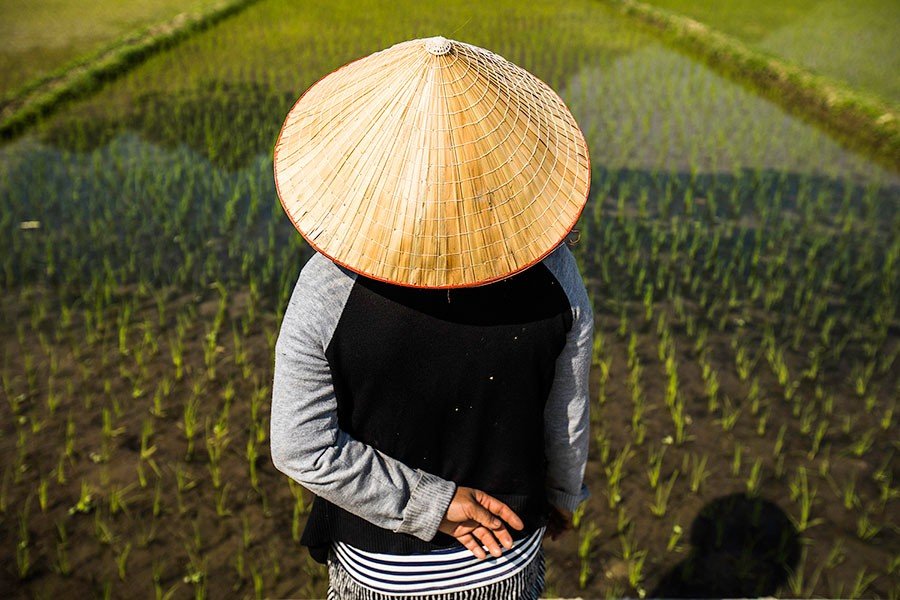
“Non la” (translated as “conical hat”) is not only a normal hat, but also one of Vietnam’s symbols of charm. Every country has its own national headgear. The United States has the baseball cap, Britain is famous for the London bobby’s helmet. Greece is associated with the fisherman’s hat, while the beret is the symbol of France. The Israelis use the yarmulke and we usually see the Saudi Arabians in their white headdresses. Indian Sikhs wrap their heads in elaborate turbans while Russians warm their craniums with fur hats, which are of good use even at fifty Degree Celsius below zero. In Vietnam, the national chapeau is the non, or conical peasant hat. Along with the graceful silk ao dai, the non has become a sort of informal Vietnamese national symbol that is recognized worldwide. How Inseparable It is? The hat has a conical shape, made out of straw and is kept on the head by a silk cloth chin trap that keeps the hat from slipping out of the wearer’s head. This traditional conical hat is particularly suitable for farmers in such a tropical country as Vietnam where fierce sunshine and hard rains take place as often as girls’ sulking. It can be used as a basin or a bowl to contain water when they are thirsty, as a fan when they are hot, as a basket of a bunch of vegetables. Romantically, young couples can veil their kisses behind this traditional conical hat during their dates. The legend behind the hat is that, once upon a time, there was a very tall woman who often wore a magical kind of hat made from four round leaves knitted together with bamboo. Wherever this woman appeared, clouds passed and the weather became favorable. After teaching people to plant vegetables and trees for their living, she secretly passed and ascended to the heavens. Yet, she was honored as the Goddess of Human and ever since, they have made hats in the shape of hers to protect themselves from the sun and the rain.
Inside Vietnam’s largest domestic terminal just opened at Tan Son Nhat Airport

Vietnam’s largest domestic terminal, T3 at Ho Chi Minh City’s Tan Son Nhat Airport, has completed final stages to serve its first commercial flight on Thursday. The terminal is seen from above on Wednesday, one day before serving its first commercial flight that took off for Van Don Airport in the northern Quang Ninh Province, home to Ha Long Bay. The project has completed most of its major components after nearly two years of construction. and is set for full operation on April 30, two months ahead of schedule. T3 will have an annual capacity of 20 million passengers, making it the largest domestic terminal in Vietnam. Built by the Airports Corporation of Vietnam, work on the VND11 trillion (US$445 million) terminal began at the end of 2022. The terminal has five floors and a total floor area of 112,500 square meters. It has four main sections: the passenger terminal, a multi-story car park integrated with non-aviation services, an overpass, and an aircraft parking area. T3 is located next to T1 domestic terminal, with its entrance facing the road connecting Tran Quoc Hoan and Cong Hoa streets. It features a softly curved roof that extends from the terminal to the garden at the center of a commercial-office complex, evoking the shape of ao dai (traditional Vietnamese costume). The terminal will handle domestic flights for Vietnam Airlines and Vietjet Air, while Bamboo Airways, Vietravel Airlines, Pacific Airlines, and VASCO will continue to operate from T1. Check-in counters are also installed with machines and behind them is a bagdrop system for luggage drop-off. It has 90 traditional check-in counters, 20 automatic baggage drop counters, and 42 check-in kiosks. The terminal features 25 security control gates and automatic conveyor belts, helping to save time for passengers. The terminal features 27 gates, 13 of which are equipped with telescopic bridges, while the remaining 14 are served by buses. The ground floor houses the baggage claim area, with the ceiling, tiles, signs, and conveyor belts nearly finished. Tan Son Nhat Airport earlier had two terminals, T1 for domestic flights and T2 for international flights, with an initial design capacity of 28-30 million passengers per year. However, the number of passengers passing through has exceeded 40 million per year, putting great pressure on the infrastructure. When terminal T3 is put into operation, it will handle about 80% of domestic passengers, helping to reduce the load on terminal T1, which is seriously overloaded.
A tradition of feasting: Vietnamese Tet meals
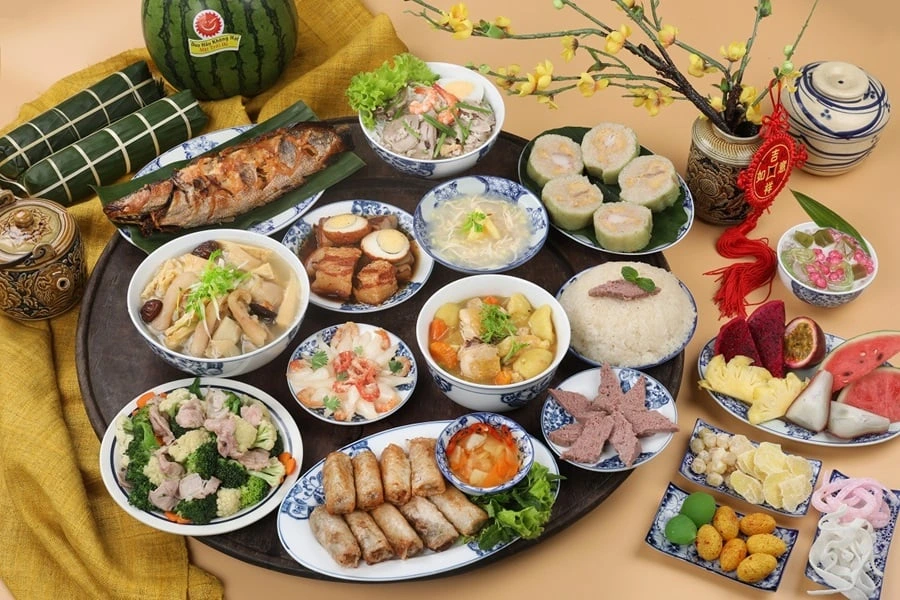
At Tet, a diverse array of dishes – from sticky rice cakes and spring rolls to boiled chicken – graces family food trays everywhere, symbolizing prosperity, luck, and familial unity. As the Lunar New Year approaches, Vietnamese households bustle with excitement and anticipation, preparing for one of the most significant and cherished celebrations of the year. Join us on a culinary journey as we explore the 10 common dishes that adorn the Lunar New Year food tray in Vietnam. Banh chung/banh tet (sticky rice cakes) Banh chung, a square rice cake, is commonly enjoyed savory in northern Vietnam, while banh tet, a cylindrical sticky rice cake and a specialty of central and southern region, can be found in both savory and sweet variations. The main ingredients of both these cakes often include glutinous rice, mung beans, pork belly, and a blend of spices such as salt, pepper, green onions, and fish sauce. These ingredients are layered, wrapped in banana leaves, and boiled or steamed until cooked through. Boiled chicken Boiled chicken, a dish originating from Chinese cuisine, holds a significant place in Lunar New Year celebrations across Vietnam. In Vietnamese culture, roosters are traditionally favored over hens in New Year offerings. The rooster symbolizes new beginnings and the start of favorable conditions for agriculture. During Lunar New Year’s Eve worship, offerings of sticky rice and boiled chicken are made, symbolizing hopes for prosperity and success in the upcoming year. The chicken is boiled until shiny and golden, infused with aromatic flavors of ginger. Accompanied by a salt and lime dip, it’s served alongside sticky rice. Gio lua/gio xao (Pork roll/ pork ear roll) Pork roll, known as cha lua in the central and southern regions and gio lua in the north, is a pork delicacy commonly found in the food tray during Lunar New Year. Meanwhile, pork ear roll is a dish often enjoyed during Tet celebrations in northern Vietnam. Xoi gac (red sticky rice) In Eastern culture, the color red represents happiness, luck, and goodness. During special occasions like Tet and ancestral ceremonies, people prepare a dish called red sticky rice. This dish is made by mixing sticky rice with gac fruit (sweet gourd). The rice is cooked until it’s soft and fragrant. The result is red sticky rice, believed to symbolize prosperity and good fortune. Spring rolls Spring rolls are known as cha gio in the south or nem ran in the north. Filled with a savory mixture of pork, shrimp, carrots, wood ear mushrooms, glass noodles, and bean sprouts, then wrapped in rice paper. The rolls are fried to perfection, resulting in a golden hue and a crispy exterior. Braised pork with duck eggs Braised pork with duck eggs is a Tet dish widely enjoyed in southern and central regions. Prepared with pork belly, garlic, shallots, soy sauce, sugar, and fish sauce, braised pork is simmered in a blend of coconut water, garlic, and shallots. Slow-cooked alongside duck eggs until tender, it’s commonly served alongside rice or pickled mustard greens. Stuffed bitter melon soup Canh kho qua, or stuffed bitter melon soup, is another dish enjoyed during Lunar New Year in southern regions of Vietnam. It’s made by filling bitter melons with a mixture of ground pork, fish, mushrooms, and spices, then simmering them in broth until tender. The name kho qua, or bitter melon, explains the wish for all kho, sorrows and misfortunes of the old year, to qua – pass, to receive good news in the new year. Dua hanh and cu kieu (pickled leeks and shallots) Pickle dishes like dua hanh (pickled shallots) and cu kieu (pickled leeks) are commonly found on festive menus. Pickled shallots are a favorite in northern regions, whereas pickled leeks are preferred in the south. Their mildly sour, slightly spicy, and aromatic flavors serve to offset the richness of dishes such as braised pork and sticky rice cakes.
Ao dai: Vietnam’s traditional dress
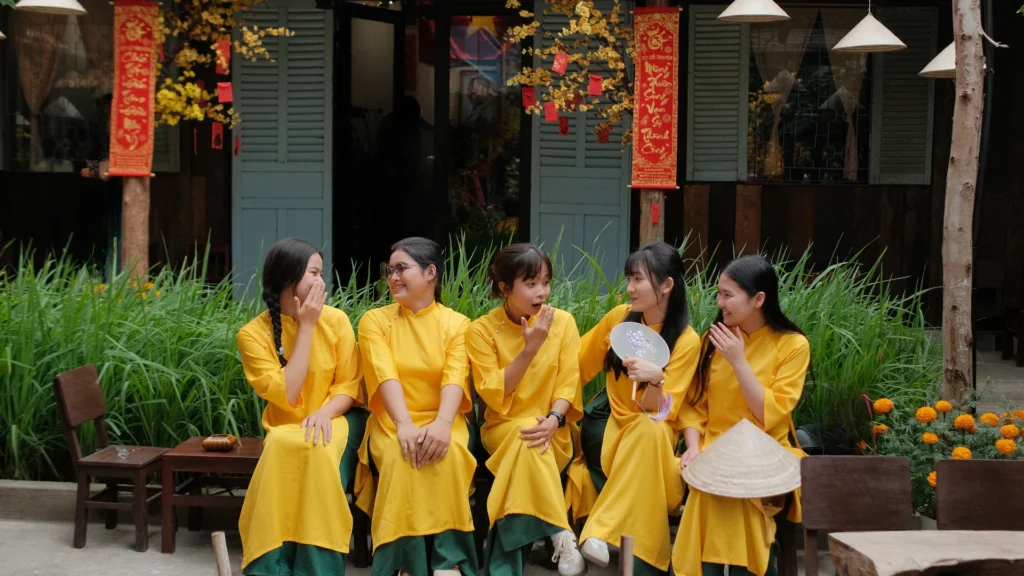
Vietnam’s national dress, the áo dài is one of the country’s most striking symbols of beauty. Over hundreds of years, the áo dài has evolved alongside Vietnam, going from regal to practical, humble to high fashion, and back again. The Vietnamese áo dài is appreciated by the young and old alike, and its elegant lines flatter both men and women. A Brief History of the Ao Dai Though scholars disagree on whether the modern ao dai has its roots in southern or northern Vietnam, which were separate kingdoms in the 18th century, both regions did have costumes that gained prominence simultaneously. A fair compromise might be to say trousers and term ao dai is derived from the South, while the long, womanly tunic came from the North. Cham Ao Dai of the South In 1744, Nguyen Phuc Khoat, ruler of southern Vietnam, decreed that all male and female nobility must don a very loose-fitting, front-buttoned gown and trousers. In order to curry favor with the native Cham people, the ao dai drew influences such as colors and patterns from their centuries-old attire. Ao Tu Than and Ao Ngu Than of the North Simultaneous to the Cham-inspired ao dai were two styles of dress in northern Vietnam. The 4-part ao tu than was worn by working-class women and comprised of a loose outer tunic, a long skirt, an undergarment shirt and cloth sash tied around the waist. The shirt is open in front, similar to a bathrobe, while darker colors were preferred due to its likelihood of getting dirty through manual labor. Conversely, women from high society sported the 5-part ao ngu than (pictured above-left). Unlike its lower class counterpart, the ao ngu had a closed front, brighter colours, raised collar and did not require a cloth belt. The most crucial element which would be adapted into the modern ao dai were the hanging flaps in front and back, along with the trademark side slits. When to wear áo dài Vietnamese women love wearing áo dài for photo shoots in beautiful settings. Golden Autumn days in Hanoi call for photo sessions around Hoàn Kiếm Lake. During Tết (Lunar New Year) you’ll see the dress in all its glory as women wear it to visit friends and family and pay tribute at temples and shrines. A wedding is the perfect time to wear one’s best áo dài. In Vietnam, the bride and groom and the wedding entourage will wear elaborate áo dài at the traditional ceremony, then guests will show up for the reception in simpler but equally colorful designs.
Coffee shop with view of lit-up, dazzling Notre Dame Cathedral
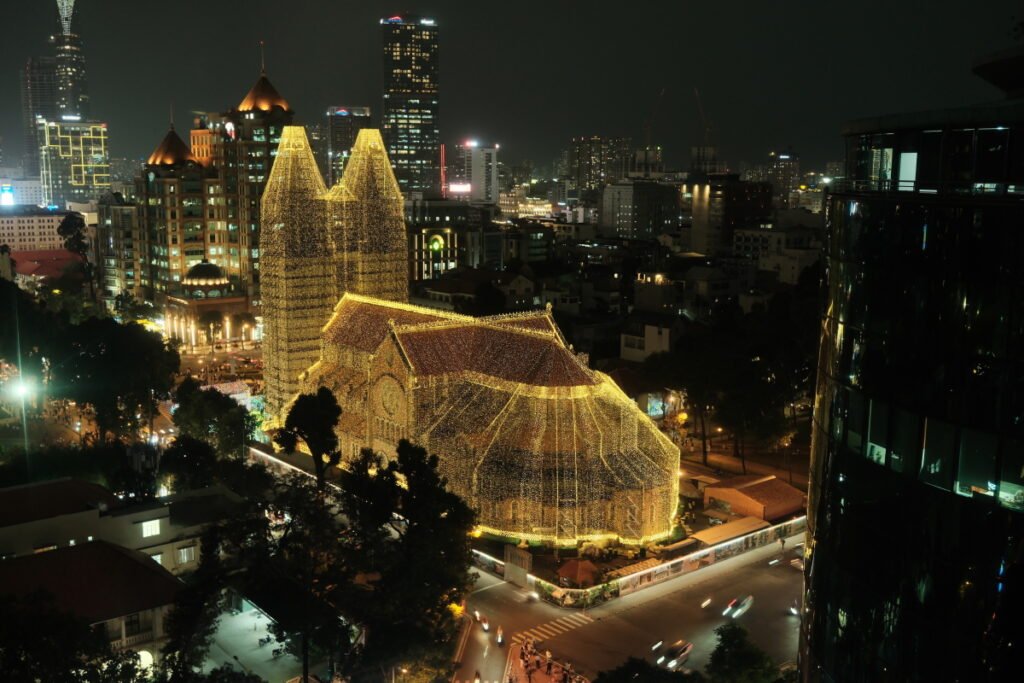
A cafe in District 1, HCMC, with a panoramic view of Notre Dame Cathedral has become a popular tourist spot since the church was lit up for Christmas. The café has large glass windows, offering views of the high-rise buildings in District 1 and a view of the area around Notre Dame Cathedral. “The cafe is usually crowded between 6 p.m. and 9 p.m. when the cathedral lights are up,” An says, adding that during peak hours it serves hundreds of customers going in and out in a constant stream. When the cathedral lights up, the cafe dims its window lights, allowing customers to take photos and enjoy the view. The café opens at 8 a.m. and closes at 10 p.m. Prices for drinks range from VND75,000 to 115,000 ($ 2.95-4.50). Located on the 13th floor of Diamond Plaza in Le Duan Street in District 1, Space 13