
The house is located in an alley connecting Nguyen Dinh Chieu and Vo Van Tan streets, right in a bustling and densely populated area of District 3. The owner of the house was Mr. Tran Van Lai (also known as Mai Hong Que), who passed away in 2002 and was posthumously awarded the title of Hero of the People’s Armed Forces by the Party and State in 2015.
Greeting us at the entrance to the bunker, Mrs. Dang Thi Thiep, wife of Mr. Tran Van Lai, emotionally recounted the nearly year-long process of digging this secret bunker with her husband to use as a weapons storage base, preparing for the Saigon Commando Force’s attack on the Independence Palace during the Tet Offensive of 1968.
“This tunnel was dug by me and him. Back then, I was just a young girl of nineteen or twenty, so I was strong and healthy, climbing up and down, carrying earth and stones to help him. It took almost a year to finish,” Mrs. Dang Thi Thiep recounted.
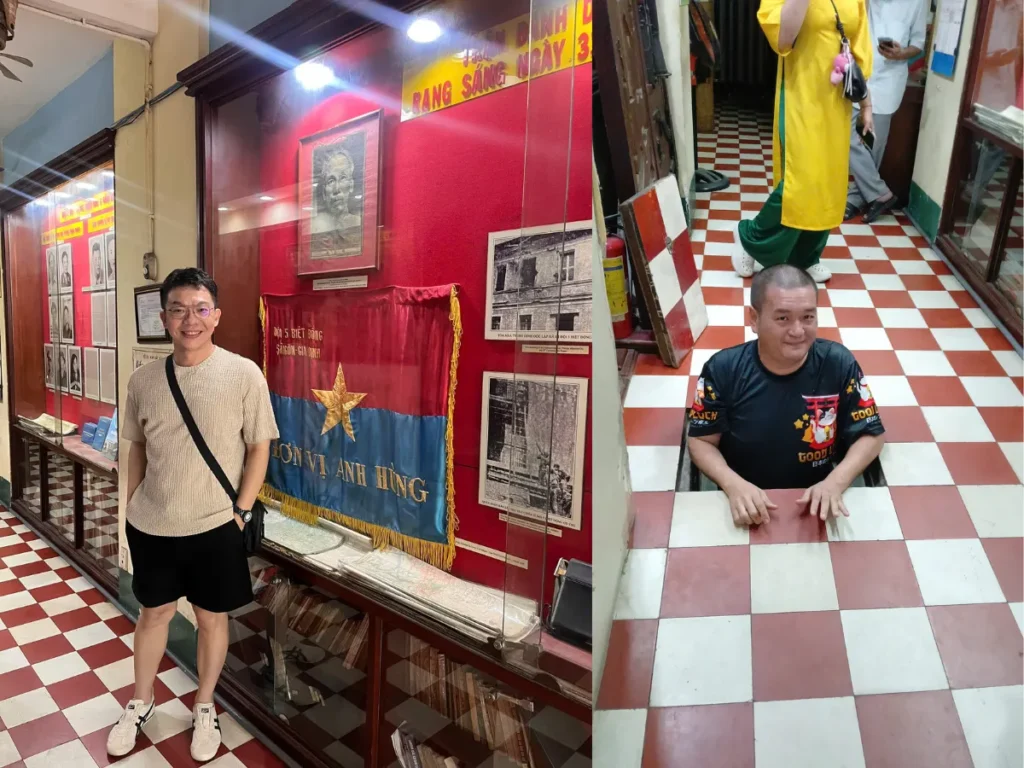
Many foreign tourists come to visit and experience the secret weapons storage bunker of the Saigon Commando Unit.
See more: 9 Traditional Vietnamese Folk Games That Bring Back the Joy of Childhood
According to Mrs. Thiep’s account, at that time, in order to build a secret weapons storage facility near the Independence Palace, right in the heart of enemy territory, Mr. Tran Van Lai bought three adjacent houses in the area. “The superiors assigned him the task of buying houses near the Independence Palace to use as weapons storage bunkers. In 1965, he drove me to the area to view the houses. Back then, the area was very desolate, with dirt roads and dilapidated houses, not as modern as it is now. After buying the houses, in 1966 and 1967, my husband and I started digging the bunker. We dug at night to avoid detection. When the superiors inspected the bunker and approved it, we began transporting weapons at the end of 1967,” Mrs. Thiep added.
At that time, to transport weapons from the base to be hidden in this secret bunker, Mr. Tran Van Lai, under the guise of a contractor at the Independence Palace, secretly transported over 2 tons of various weapons in three trips by car to hide them in the bunker. According to Mr. Lam Quoc Dung, a former intelligence officer of the Saigon Special Forces, the enemy’s inspections were very strict back then. To transport weapons into the city center, a “cover” was needed to deceive the checkpoints. The transporter also had to be very brave, resourceful, flexible, but also courageous and calm when facing the enemy.
“Only Mr. Tran Van Lai could have done that. At that time, Mr. Lai was working as a contractor in the Independence Palace, so he could travel in and out of the suburbs, using cars to transport weapons without being suspected or detected,” Mr. Lam Quoc Dung added.
On the afternoon of the 30th day of the Lunar New Year in 1968, 17 soldiers of the 5th Saigon Special Forces Unit gathered at the house of Mr. Tran Van Lai, receiving weapons and cleaning up in preparation for the attack on the Independence Palace. Ms. Vu Minh Nghia (also known as Chin Nghia), the only female soldier who directly participated in the attack on the Palace that year, recounted: “When we arrived, the soldiers opened the hatch of the bunker for us to see what was inside. I was utterly astonished and impressed. The bunker was about 8 meters long, 2 meters wide, and 2.5 meters deep, filled with all kinds of weapons. From grenades, explosives, AK rifles, B40 rocket launchers… more than 2 tons.”
Ms. Chín Nghĩa said that she admired Mr. and Mrs. Trần Văn Lai because she came from the Củ Chi area and had participated in digging tunnels, so she understood how difficult and dangerous tunnel digging was. Digging tunnels right in the heart of enemy territory was even more difficult and dangerous. “The tunnel wasn’t small and contained so many weapons. Mr. and Mrs. Năm Lai risked their own lives and the lives of their families to accomplish such a feat,” Ms. Chín Nghĩa added.
After liberation, Mr. Tran Van Lai and his family redeemed and restored the house, and also painstakingly searched for, collected, and purchased artifacts and documents about the Saigon Commando Unit to display and introduce. Each artifact tells a vivid story, including the process of “camouflaging” the transportation of weapons from the base to be hidden in the bunker. Notably, the exhibition also displays and introduces the Citroen NCE-345 car that Mr. Tran Van Lai used to transport weapons and soldiers of Team 5 of the Saigon Commando Unit during the attack on the Independence Palace.
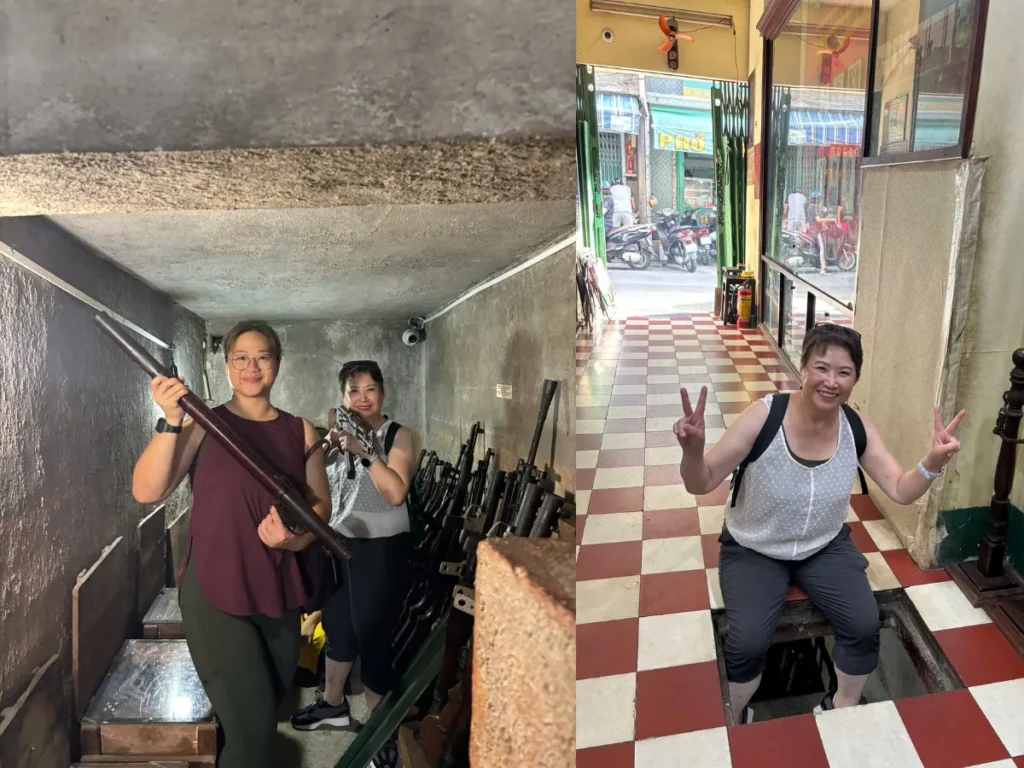
Measuring 8 meters long, 2 meters wide, and 2.5 meters deep, the bunker was the largest and contained the most weapons of the Saigon Commando Unit.
See more: 9 Things That Shock Foreigners in Vietnam – But Are Totally Normal for Vietnamese People
According to Mr. Nguyen Tien Dang, son of Mr. Nguyen Van Tri (also known as Hai Do), his father, who was then the Political Commissar and Head of the A20-A30 Combat Support Unit of the Saigon Special Forces, commanded the digging of tunnels in the city center to hide weapons in preparation for attacks on the headquarters and key agencies of the Saigon puppet regime. “Uncle Nam Lai’s tunnel was the largest and contained the most weapons of the Saigon Special Forces at that time,” Mr. Dang shared.
In 1988, the house was recognized as a National Historical Monument, named the Weapons Storage Bunker of the Saigon Commando Unit that attacked the Independence Palace during the Tet Offensive of 1968. Today, it is one of the “red addresses” that attracts thousands of people and tourists to visit and learn about history. Through this, it serves to promote and educate about the sacrifices and hardships endured by the Saigon Commando Unit for the cause of national liberation and reunification, while also spreading pride in patriotic traditions and inspiring future generations to preserve and protect the Fatherland.
♥ Saigonbiketours – Food Tour In Saigon ♥
Vietnamese source: https://www.qdnd.vn/50-nam-dai-thang-mua-xuan-1975/can-ham-bi-mat-cua-biet-dong-sai-gon-chua-hon-2-tan-vu-khi-giua-long-tp-ho-chi-minh-825561